Showing posts with label Highest Recommendations. Show all posts
Monday, June 1, 2015
Soundtrack of the Month: June 2015
Are you tired of reality? Take a trip to the beautifully hand-drawn world of Falana, and experience the adventure of an amnesiac swordsman, an adorable nimbat, and a talking sword.
Dust: An Elysian Tail is another fine example that video games are truly a form of art. The story, artwork, music and gameplay all come together to create an incredible experience. What's more, aside from sound design, the majority of the game was developed entirely by one man, Dean Dodrill. The amazing soundtrack was composed by HyperDuck Soundworks, with a few additional tracks by Alex Brandon.
In 2008, a groundbreaking indie video game called Iji was released, featuring an awesome, hard rock soundtrack. It was the first project that HyperDuck Soundtrack ever composed as a team. Jump ahead four years, and not only had they become a lot more experienced, but now their music is some of the greatest in the soundtrack industry.
Originally, the soundtrack was to have a style inspired heavily by entries in the Ys series of video games. Eventually a decision was made to majorly rework the soundtrack to have a more cinematic feel to it. This changed the soundtrack from what would have been a great soundtrack to what was ultimately an absolutely incredible soundtrack. The original versions of some of the songs are still included on the album as the "vintage" bonus tracks.
The story of Dust is intriguing, emotional, and often humorous. The player will undoubtedly tear up a number of times. Dean Dodrill has also been in the process of making a movie that takes place in the same universe. This project has been in development for over two decades. Additionally, it's possible that in the future he will create other games that take place in the world of Falana. We can only hope that HyperDuck will be involved in these other productions as well.
Featured Tracks
Track 1: Falana – The title music of the game, and one of four tracks composed by Alex Brandon. When you hear this music, you know you're in for quite a journey ahead. It also shows up every so often for emotional scenes throughout the game.
Track 7: Short Fuse – This is one of three renditions of the boss theme. The other two are Track 11: Deities and Track 17: Heavy Bones.
Track 8: Abadis Forest – Whenever I tell somebody about this game and its soundtrack, I usually send along this song as part of the pitch. I consider it the perfect musical representation of the game and soundtrack.
Track 15: Everdawn Basin – This is the music for the final stretch of the game. It's rather epic.
Purchase the Dust: An Elysian Tail soundtrack on Loudr, Bandcamp, or iTunes.
Or listen to it for free on Spotify or YouTube.
Also check out the trailer for Dust: An Elysian Tail.
Sunday, March 1, 2015
Soundtrack of the Month: March 2015
When attempting to plan future editions of this Soundtrack of the Month series, there is one soundtrack that kept coming up again and again, that I kept getting very close to rejecting. I kept considering it because it's great music, and I kept rejecting it because it was made by an amateur—somebody who had never composed before, and has even stated he can hardly play a musical instrument. However, eventually I came to the conclusion that I don't care that the composer was new when he created this soundtrack, because it's honestly one of my favorite soundtracks... ever.
Ring Runner: Flight of the Sages is a video game mainly developed by two brothers (and a wife/sister-in-law), over the course of five years. Enrique and Paul Dryere were in college and decided to make a game; simple as that. Over the years their project would grow and grow, becoming more and more ambitious, but they didn't stop work until it was everything they wanted it to be, and the result was staggering. The game that came out was an extremely well-polished product, with an incredible 20-hour story, and numerous game modes and features. This game looks and functions like it was made by a large team of people, but it wasn't. It was mainly two.
Ring Runner is very much a game for intellectuals. If you're not a quick learner, you are going to be very lost. The Dryeres packed in so much science and technical details—a lot of it their own science fiction; a lot of it actual theoretical science—that sometimes it's difficult to understand everything that's happening and being said. It most certainly made my head hurt a number of times, and sometimes I had to replay certain sections just so I could be sure of what the characters said. Even the controls are difficult to master, as they're more complicated than the average space shooter.
The game's soundtrack is composed by Enrique "E.C." Dryere, and as I said before, it was his first time composing music. The first track he ever composed is even included on the soundtrack as a bonus track (Track 20: The First Sage). At first the soundtrack might seem to have a slight sort of amateur feel to it, but for me that has long worn off. Instead, I have a strong appreciation for how unusual and unique the style of music is. In fact, it's one of the most unique soundtracks I've heard.
The Ring Runner soundtrack is a piece of art. It's an integral part of the game. Not only is it beautiful, but it perfectly reflects both the vastness of space and the universe in which the game takes place. The score that accompanies the Nameless Sage on their adventure is incredible. It might be a little unorthodox, but that doesn't make it any less amazing. I would say that there is only one track in the entire soundtrack (Track 19: A Promise to Keep) that doesn't fit perfectly with the segment of the game in which it is used, and that single track is still a great piece of music on its own.
Featured Tracks
Track 15: Ring Runner – This is the music that greets a player when they load up the game. It's rare that a piece of music can invoke such a feeling of nostalgia before one has even been through the journey. The title music of Ring Runner is somehow able to accomplish this. It expresses the vastness of space, and at the same time lets the player know that they're in for a long, incredible journey.
Track 1: StarEater – This music helps craft the first level of the game. An amnesiac pilot and a mysterious A.I. fly their way out of an exploding space station. In short, the story begins with the destruction of the only location that could ever tell the characters who they are.
Track 7: The Name Solipso – A recurring character, with a recurring theme, is the legendary Sage named Solipso. The first ever Sage free of CIR rule, Solipso has been on the run for hundreds of years, showing up at various locations for only brief amounts of time. One day he crosses paths with the Nameless Sage, and that simple meeting would set in motion events that would change the universe, so to speak.
Purchase the Ring Runner: Flight of the Sages soundtrack on Bandcamp.
Or listen to it for free on Bandcamp or YouTube.
Thursday, January 1, 2015
Soundtrack of the Month: January 2015
Happy New Year! Welcome to the sixth installment of the Soundtrack of the Month series. As this marks approximately half a year since the beginning of the series, I thought I'd do something special.
When somebody asks me what my favorite animated movie is, I'm always ready with an answer. When somebody asks me what my favorite movie score is, I'm always ready with the exact same answer. How to Train Your Dragon is an adorable and epic tale of Vikings and dragons. Man and beast have been at war for far longer than either can remember, and the one person that nobody thinks could ever make a difference is Hiccup Horrendous Haddock III, a young boy who cannot fight to save his life. To avoid summarizing the entire plot and giving away key details, let's just say everybody was wrong.
The score of How to Train Your Dragon was composed by John Powell. It's really flipping good. You should listen to it.
I feel obligated to mention that the credits song was written and performed by Icelandic musician Jónsi. A lot of people have praised the film's soundtrack for this song alone, but I wouldn't go that far. It's a good song, and I like to listen to it on occasion, but when compared to the magnificent rest of the soundtrack it's almost mediocre.
Featured Tracks
Track 1: This is Berk – One of the greatest opening tracks in the history of filmmaking. "This is Berk" is commonly the first voice-over line in various installments of the DreamWorks Dragons franchise. Berk is the name of the region in which the Vikings live in the film and sequential stories.
Track 11: Test Drive – Reason #47 why How to Train Your Dragon is my favorite movie score ever: Listening to the music makes you feel like a superhero.
Track 21: Counter Attack – Reason #84 why How to Train Your Dragon is my favorite movie score ever: John Powell makes sure there is never a monotonous moment in the score. Even in the darkest and most tense moments his epic and distinct themes are heard throughout.
I have to remind you once again that these three tracks are not necessarily my three "favorite" tracks. If I were to list all of my favorite tracks for this soundtrack, I would have to list pretty much the entire album. Some very honorable mentions that didn't make the "Featured" list include Forbidden Friendship (Track 8) and Romantic Flight (Track 15). Oh, and all of the rest.
Purchase How to Train Your Dragon: Music from the Motion Picture on Amazon or iTunes.
Or listen to it for free on Spotify or YouTube.
When somebody asks me what my favorite animated movie is, I'm always ready with an answer. When somebody asks me what my favorite movie score is, I'm always ready with the exact same answer. How to Train Your Dragon is an adorable and epic tale of Vikings and dragons. Man and beast have been at war for far longer than either can remember, and the one person that nobody thinks could ever make a difference is Hiccup Horrendous Haddock III, a young boy who cannot fight to save his life. To avoid summarizing the entire plot and giving away key details, let's just say everybody was wrong.
The score of How to Train Your Dragon was composed by John Powell. It's really flipping good. You should listen to it.
I feel obligated to mention that the credits song was written and performed by Icelandic musician Jónsi. A lot of people have praised the film's soundtrack for this song alone, but I wouldn't go that far. It's a good song, and I like to listen to it on occasion, but when compared to the magnificent rest of the soundtrack it's almost mediocre.
Featured Tracks
Track 1: This is Berk – One of the greatest opening tracks in the history of filmmaking. "This is Berk" is commonly the first voice-over line in various installments of the DreamWorks Dragons franchise. Berk is the name of the region in which the Vikings live in the film and sequential stories.
Track 11: Test Drive – Reason #47 why How to Train Your Dragon is my favorite movie score ever: Listening to the music makes you feel like a superhero.
Track 21: Counter Attack – Reason #84 why How to Train Your Dragon is my favorite movie score ever: John Powell makes sure there is never a monotonous moment in the score. Even in the darkest and most tense moments his epic and distinct themes are heard throughout.
I have to remind you once again that these three tracks are not necessarily my three "favorite" tracks. If I were to list all of my favorite tracks for this soundtrack, I would have to list pretty much the entire album. Some very honorable mentions that didn't make the "Featured" list include Forbidden Friendship (Track 8) and Romantic Flight (Track 15). Oh, and all of the rest.
Purchase How to Train Your Dragon: Music from the Motion Picture on Amazon or iTunes.
Or listen to it for free on Spotify or YouTube.
Saturday, November 1, 2014
Soundtrack of the Month: November 2014
For some odd reason, I have not watched a lot of anime. I'm not exactly sure why this is, as one thing I've learned over time is that anime music is incredible.
RWBY (pronounced "Ruby") is a 3D anime-esque webseries that takes place in the fantastical and awesome world of Remnant. It focuses on the story of Ruby Rose, a fifteen-year-old girl who wants to become a Huntress in order to defend the kingdoms of Remnant from the nefarious creatures of Grimm. The music is composed by Jeff Williams, and the vocals on many songs are performed by his daughter, Casey Lee Williams. Some additional composing was done by Steve Goldshein and Alex Abraham.
Jeff Williams is previously known for scoring three seasons of the machinima webseries Red vs. Blue, also by the creators of RWBY. While the soundtrack was incredibly awesome for that series while Williams was the composer, I must warn you that both the soundtrack of Red vs. Blue and the series itself are incredibly unclean. Investigate further at your own risk. (Here is a clean example of the soundtrack, coincidentally featuring Casey Lee Williams.) RWBY, however, was intended to be clean from the very beginning, and the soundtrack only includes a few instances of mild language.
Williams is easily one of my favorite composers of all time. The music he writes is right out of a JRPG, and it fits perfectly with the world of RWBY. Additionally, his songwriting is incredible.
The soundtrack to RWBY, Volume 1 comes on two discs—Disc 1 is the "soundtrack", which contains all the songs that contain lyrics; Disc 2 is the "score", which includes sixteen tracks, one for each episode of Volume 1. The first disc includes a wide assortment of tracks. A few of the songs only appear in the series, in part, as brief credits music for individual episodes, whereas on the soundtrack disc they are complete songs. Additionally, some of the songs have multiple versions that are included in the same release.
For an example of how well the music and animation work together, I recommend you check out the Red Trailer, White Trailer, Black Trailer, and Yellow Trailer. These four trailers were released over time leading up to the premier of the series, and each one announced and introduced one of the four lead characters. Musically, the Red Trailer introduces Ruby's theme, the White Trailer introduces Weiss's theme, the Black Trailer introduces Blake's theme, and then the Yellow Trailer does a remixed medley of all three previous character themes before finally introducing Yang's theme in the final minute. Ruby, Weiss, and Blake's themes are heard instrumentally all throughout the series.
Incidentally, there's a specific reason why I chose this month to feature this soundtrack. One reason is that it's one of my favorite soundtracks, ever, and I couldn't wait to feature it. The more prominent reason is that the incredible lead vocalist of RWBY, Casey Lee Williams, turns sixteen this month. Just let that sink in a little. She was only fourteen when this album was recorded, and she had more talent than you will ever have in your life. Yup.
It's my recommendation that you watch through RWBY, Volume 1 before you listen through the soundtrack extensively. It's not a necessity; it's just my recommendation. Don't fret, though, because you can watch the entire series so far, absolutely free, on YouTube, the Rooster Teeth website, and Crunchyroll. Volume 2 of the series concluded a mere two days before this post was published, so we should be seeing the release of the next soundtrack quite soon as well.
Featured Tracks
Disc 1, Track 1: This Will Be the Day – The theme music for Volume 1 of RWBY. The first verse and refrain are played (along with an intro cinematic) at the end of the first episode, and then the refrain and a shorter shorter version of the cinematic play at the beginning of every other episode for the rest of the season. An epic theme song that fits perfectly with the story.
Disc 1, Track 3: Mirror, Mirror (White Trailer) – Weiss's theme is perhaps my favorite character theme. (I say perhaps because they're all very good.) Casey Williams is Weiss's singing voice, and while she doesn't sound exactly like Weiss, it's still an incredible song.
Disc 1, Track 9: Red Like Roses, Part II – Red Like Roses is Ruby's theme, first heard in the Red Trailer. The Red Trailer begins by showing Ruby visiting her mother's grave, as Casey sings a few poetic lines about each of the four main characters. Red Like Roses Part II is a standalone song that works as a sequel to Red Like Roses. Casey sings from Ruby's point of view, expressing her desperation and loss about the death of her mother. Casey's real-world mother, Sandra Lee Casey, sings from the point of view of Ruby's mother, expressing what she would have said to her daughter if she'd had a chance before she died. This is one of my absolute favorite songs to listen to. The first verse and refrain are heard in Episode 8.
Disc 2, Track 1: Ruby Rose – The score to the first episode of RWBY. It begins with the slow, dramatic music that accompanies the prologue (which is narrated by Jen Taylor), before transitioning into the beautiful and eerie cello and piano duo that introduces the villain Roman Torchwick. After that we hear our first battle music of the series, which sprinkles in a few instrumental bits of Ruby's theme, Red Like Roses. We then move on to an interrogation scene, and we end with being introduced to the theme of Beacon Academy. This track covers many moods and scenes, and there's not a dull moment.
Disc 2, Track 8: Players and Pieces – Episode 8 was arguably the most epic episode of Volume 1. It's filled with epic score and some darn epic battles. Be prepared for Nora's obnoxious (but hilarious) "I'm queen of the castle!" to pop in along the way. Additionally, Episode 8 was the episode that featured Red Like Roses Part II, and this track includes the instrumental build-up of the song that is not featured in the version of the song that's included on Disc 1. The track is concluded by reprising Torchwick's theme from the first epsisode.
Disc 2, Track 16: Black and White – The final episode of Volume 1. Many cool variations of themes, including a battle version of Torchwick's theme. The fact that the three tracks I picked to feature in this just happened to be the three that feature Torchwick's instrumental theme is mere coincidence. It is a really cool theme, though.
Note: Track 7 (I Burn), Track 9 (Red Like Roses, Part II), and Track 10 (I Burn Remix) contain brief instances of mild language. Additionally, the iTunes single version of I Burn contains explicit swearing.
Purchase the RWBY, Volume 1 soundtrack on the Rooster Teeth Store or iTunes.
Or listen to it for free on Spotify or YouTube.
Monday, September 1, 2014
Soundtrack of the Month: September 2014
Welcome to the second entry in the Soundtrack of the Month series. Last month we plunged into darkness with the debut of the blog series, and this week we shall rise into the light. Child of Light is a gorgeous video game about a little girl from 1895 Austria who was thought to have died, but instead woke up in the fantastical world of Lemuria.
Child of Light is a prime example of how video games are most certainly an art form. The visuals are incredible, the dialogue is all in poetry, and the music is absolutely beautiful. Each aspect of the game is a beautiful piece of art on its on, but they all come together to create something even greater. For a greater grasp of what I mean, you can check out the trailer.
The score was composed by French-Canadian singer Béatrice Martin, who goes by the name Cœur de pirate ("heart of the pirate"). I don't know how much experience she's had with composing, but this is her first ever score release, and it's easily one of the best video game soundtracks I have ever heard. The melodies are fairly simple yet beautiful, and the tunes will remain in your head for a very long time.
Beyond being an incredible background score for a game, the soundtrack to Child of Light is an amazing listen on its own. If you're looking for music to listen to while you're writing or drawing, look no further than this album.
Featured Tracks
Once again I remind you that this section does not necessarily show my three favorite tracks. In all honesty, if I were to list my favorite tracks, I would list nearly the entire album. Rather, here are three noteworthy tracks.
Track 2: Aurora's Theme – This is the theme of the main character, Aurora. It's heard many times in the game and multiple times in the soundtrack. It reflects the innocence of her youth, but also has a feeling of sadness to it.
Track 11: Metal Gleamed in the Twilight – While most of the tracks from Child of Light were recorded with only a few instruments, the battle themes were fully orchestrated and, to be honest, rather epic. This track is my particular favorite of the orchestrated themes.
Track 18: Off to Sleep – The credits song to Child of Light, written and performed by Béatrice. It's an amazing song on its own, but in my experience the best way to listen to it is at the end, after listening to the entire rest of the soundtrack. It's an incredible and emotional conclusion, both to the game and to the soundtrack.
Note: In the game, some of the orchestrated tracks include a choir. The choir was edited out for the soundtrack release, but that in no way detracts from the soundtrack.
Purchase the Child of Light soundtrack on Bandcamp, iTunes, or Amazon MP3.
Or listen to it for free on Spotify or YouTube.
Monday, August 25, 2014
Television Review: Arrow - Seasons 1 & 2
The story focuses on Oliver Queen, a young man from a family of billionaires. Five years ago he went on a trip in his father's yacht with his father and his girlfriend's sister. (That last part was obviously not a good idea.) Something happened, causing the yacht to sink. Oliver was the only survivor, and after days in a lifeboat he made it to an island where he would be stranded for the next five years. Fast forward to present day, Oliver is finally rescued and brought home—but unknown to those around him, he was given a mission by his father before he died, and Oliver has every intention of carrying it out. At night he dons a suit and hood with the intent of putting an end to the corrupt men and women who take advantage of others and rule their city through fear.
Right off the bat, the series shows itself to be strong. A young man returns home after being stranded on an island for five years... but nobody knows what really happened to him. He's a mystery. Unbeknownst to the people of Starling City, Oliver has also acquired incredible skills in archery and other manners of physical abilities. What's more, the viewers don't know how he acquired these skills either, which introduces us to one reason why this show is so spectacular: It shows the story of two timelines, not one.
The narrative alternates between the present-day adventures of the mysterious "Vigilante" and the five-years-past adventures of a broken and lost Oliver Queen, and how he becomes the so-called Vigilante. The latter storyline is usually depicted gradually, with an episode's narrative focused on the present day. However, at least one episode of each season switches the priorities of the narrative, meaning that, conversely, the episode focus is on Oliver's island story and the present-day part is shown in shorter fragments.
The Present-Day Story of Oliver Queen
However, Oliver has higher priorities to think about than his furious former friends. He's on a mission to save his city. Before his death on the yacht, Oliver's father told him that he'd not been the person Oliver thought he was. He'd done terrible things, and wished more than anything that he could atone for his sins. He told Oliver to make things right, and now Oliver has every intention of doing just that. His father left him a book of names, of corrupted people in Starling City who were taking brutal advantage of people lesser than them. Oliver uses this list as a reference as he sets out to give these corrupt individuals a second chance, and if they refuse than to take more drastic measures.
What follows is an epic and thrilling adventure full of action, mystery and betrayal. An unforgettable cast of characters is introduced throughout the story, portrayed by some of the most superb actors in the industry. The writing is superb, the actors are fantastic, and the presentation is incredible. Oh, and the music? It's awesome. As the series progresses the characters continue to change and develop, and the story goes in all sorts of different turns. Throughout the first two seasons you get to watch as Oliver Queen, the Vigilante, gradually transforms from a dark antihero into the savior of Starling City. But still, after all this, there is so much we have not learned about how he became who he his.
Oliver Queen and the Island
Oliver tells people that he survived on the island alone for five years. However, that is quite a distortion of the truth. His body is covered in scars—how could this be so if he had been alone? Beyond that, the viewers know that he somehow turned from a spoiled kid into an expert warrior and archer during his time on the island. Again, how could this be so if he had been alone? Well, the truth of the matter is, he wasn't. In fact, he had many adventures on this island, and most of them were not pleasant.
As time passes in the present-day narrative, the same amount of time passes in the island narrative. Meaning, at the end of Season 1, the present-day narrative shows an Oliver that's been home for a year, and the island narrative shows an Oliver that's been on the island for a year. With that being said, after the eventual Season 5 (if the series lasts that long—which I most certainly hope it will), the island narrative will probably cease, because it will have reached the point at which Oliver got rescued present-day at the beginning of Season 1. I honestly cannot wait to see what they do with the narrative after that.
The island narrative is a really cool part of the series. First you have this really cool present-day story involving dark heroes and mastermind villains, while at the same time being shown the story of a castaway on an island full of danger and fear. I've done my best not to spoil much of the story for either narrative, as I feel it's best for you to experience them for yourself.
The Terrible and Brilliant Drama of Arrow
If there's one thing my dad doesn't like, it's character and relationship drama. Disagreements, misunderstandings, dysfunctional relationships... they can really ruin a story. Unfortunately, Arrow is full of this drama. Fortunately, it's not too much to ruin the story. On almost any other series it would be, but yet Arrow is additionally full of brilliant writing and story that is able to outweigh some of the drama that we wish would not be there.
Arguments happen, relationships happen, drama happens. Oliver knows that he was not a good man five years ago, and he retains some of his not-so-great tendencies to the present day. He still knows they're wrong, and that's one of the more intriguing parts of his character development over the years. Other characters have family and relationship problems, and they intermix, and... well... I'm not sure my dad would like this show.
...But it's so awesome! I said it before; the storytelling definitely makes up for the drama.
Even when the drama is at its worst, the actors are so incredibly amazing at acting the parts. So, even when a scene is not the funnest to watch, the presentation is still top notch. I cannot stress enough how amazing these actors are.
Season One vs. Season Two
There is actually quite a contrast between the first two seasons, both in the present-day narrative and the island narrative. For the sake of avoiding spoilers, I will only talk about the present-day narrative here.
The first season is about a man making up for the wrongs of his father. Oliver Queen is on a mission to cleanse Starling City of the corrupt individuals who hold the citizens of the city in a state of fear. He's ruthless, and while always making sure to give his adversaries a chance to right their wrongs, isn't afraid to drop bodies to make a point. He's by no means a hero; he simply has a mission and needs to see it carried out.
Season 2 is different. Things have happened, and he's changed. He goes from being not a hero to trying to be a hero. He doesn't care about a mission any longer; he cares about the people of his city, and wants to do his best to save them without sending goons and villains to the morgue. This radical change in his character starts a new chapter in his life, and is a focal point in the story of the season.
Another interesting difference between the two seasons is that Season 1 feels more grounded in reality. It feels like it's a story that could have actually happened. All sorts of pop culture references lead to a feeling that this story actually takes place in modern-day, on Earth. The second season is what makes the series start to feel more like it's from the DC universe. Subtle hints are dropped that there may exist people with supernatural abilities, and a serum that can induce superhuman strength is introduced and has a key part to play in the season plot.
In fact, a spin-off of Arrow is coming in October, called The Flash (based on the DC character of the same name). That series looks like it's going to have superpowers everywhere. As with the Marvel Cinematic Universe, the world is changing slowly from a relatable world to a world dreamed up in a comic book. I really liked the feeling of the first season, so I'm more sure if I'm a huge fan of the way this is going. At the same time, though, the series is still incredible and is no way growing any less in its level of awesome.
Conclusion, etc.
In the end, Arrow is a wonderful telling of two adventures. The characters are amazing and relatable, the actors who play them are incredibly good at what they do, and overall the presentation is top-notch. I've also noticed a number of recurring or guest characters who are portrayed by actors I know well from other series I love. So far I've recognized two actors from Doctor Who (John Barrowman and Alex Kingston), two actors from Stargate SG-1 (Ben Browder and Teryl Rothery), and two actors from Firefly (Summer Glau and Sean Maher). I also discovered that Manu Bennett, the actor who plays the character Slade Wilson, also portrayed Azog the Defiler in the Hobbit films. That's pretty darn awesome.
I hope I've done well in explaining why I love this series so much. Honestly, you'll just have to watch it to see all the stuff I've left out. I don't expect you to watch it nearly as fast as I did, but you may be tempted. This series is da bomb! If you haven't seen Arrow yet, I very highly recommend it.
Also, for the record, I'm known for being passionate about people watching things in order, but that's usually for a good reason. The episodes of Arrow are most often not self-contained. The series is a constantly progressing story, and if you jump in at a random episode, you will jump smack into the middle of that progressing story. It'd be like opening an action-packed novel to a random chapter and reading from there. It's just not a smart thing to do, and I really don't recommend it. Please start at the beginning.
Now go watch it. Peace!
Tuesday, September 17, 2013
Hittite Warrior by Joanne Williamson
In my years as a homeschooler, I had to read a lot of literature. I still do in high school, but it's very different. One book that I read in my middle school years was Hittite Warrior by Joanne Williamson. It's historical fiction from the time of the Bible's book of Judges. I loved it when I first read it, and I was excited to pick it up again when it was assigned in high school.
The story focuses on Uriah, a Hittite who has found himself homeless and without family due to his homeland, Great Hatti, being invaded by the "sea people." He must make his way to Canaan, and eventually, though his adventures, find himself in a war between Canaan and the tribes of the Hebrews. Having no real allegiance himself, his nation being gone forever, Uriah must ultimately decide which side he is to join, and in the name of which god, if any, he will fight.
Hittite Warrior is unique, both in story and in writing style. It focuses on a portion of history largely ignored by today's society, because it was so very long ago and hardly relevant to anything anymore; but that's part of what makes it a good story. Since the reader might not know very much about this entire era, it almost feels like it could be from another world's history, rather than our own. All in all, it's fascinating.
The writing style is unique because it often moves events along at a very quick pace, almost as if the narrator is summarizing the events, but at the same time it never leaves any details ambiguous. It doesn't spend paragraphs and paragraphs explaining something, but rather explains it quickly in a way that you fully understand. It doesn't make you feel any less for the characters or their emotions. It's quite unlike almost anything else I've read, and it's very well done.
My biggest complaint with the book is foreshadowing. A lot of details are bluntly foreshadowed, but it's actually somewhat appropriate due to the writing style. It does not make Hittie Warrior any less of a spectacular read.
Hittite Warrior is a decently short book, and it's very easy to read. It tells a brilliant story with characters that the reader will care about. Uriah Tarhund makes for a great main character and narrator, and his struggle is realistic and relatable. I would never want to be in his position at any point of the book.
Overall, you should read this book. It's worth the time.
Saturday, August 17, 2013
The Rithmatist by Brandon Sanderson
Disclaimer: This review will include the basic premise of the story, told in my own way; so if you object to spoilers as much as I do, you should probably skip this review. However, if you're not that kind of person, feel free to read on. The review actually contains no spoilers beyond the basic premise.
The Rithmatist is a young adult fantasy novel written by the master of fiction himself, Brandon Sanderson. It takes place in an alternate, steampunk version of our world. It's not an alternate future; it's an alternate world entirely.
As is traditional for a novel penned by Sanderson, The Rithmatist has a unique magic system that is so utterly unlike anything else, that once you actually understand it, you're shocked by its brilliance. I could try to explain Rithmatics to you, but it's not so easy to explain. Sanderson explains how it works throughout the entirety of the novel, for you can't just learn it all at once. It takes time to understand, but it's brilliant.
In the United Isles of America, those who can use Rithmatics—they're called Rithmatists—are of much higher social class than others. That's because they are the isles' main hope of staying safe. Rithmatics involve creating things using chalk, including defenses and possible weapons. In the isle of Nebrask, there's a tower from which swarm thousands of wild chalkings—savage creatures made purely from chalk but easily capable of killing people in terrible ways. The Rithmatists are the main force keeping the chalkings inside Nebrask and not letting them get into the other fifty-nine isles, fully populated with people.
In the isle of New Britannia, Joel Saxon is a student at Armedius Academy, where they train both Rithmatists and upperclass people who don't have the power of Rithmatics. He himself is not a Rithmatist, nor an upperclassman, but rather the son of a now-dead employee of the academy. All his life he's been fascinated by Rithmatics and has always wished that he could use them, but he lost that chance long ago.
Not everyone becomes Rithmatists. In fact, only a very few amount of people do, always chosen at age 8. Every child must go through the inception ceremony when they're young, which will completely determine their future. If they go through the ceremony and nothing changes, they go on with their lives. If they suddenly discover they can use Rithmatics, they get ridiculous privileges, get education at a special school (such as Armedius), serve in Nebrask for ten years, and then get a pension for the rest of their lives.
As a summer elective before his final year at Armedius, Joel finds himself working with the Rithmatist Professor Finch (a non-Rithmatist working with a Rithmatist is almost unheard of) on a secret project involving the disappearances of a couple Rithmatist students off-campus. Thus begins the fascinating and brilliant story of The Rithmatist.
Now, by this time I know Brandon Sanderson. I know he's going to have amazing, likable characters; I know he's going to have a brilliant magic system that will blow my mind once I properly understand it; I know that he's going to have plot twists that will make Ted Dekker look like the writer of children's books. That last fact is a trademark of Sanderson. If you think you know where the story is going, something's going to change that you will never see coming. That will happen numerous times with every book you read that he has penned.
If there's somebody who knows how to craft a story better than anyone else, it's Brandon Sanderson. He'll always leave hints to things along the way that you'll never pick up on when you first read a story. Things that will later blow your mind. As always, Sanderson has created a brilliant world with a fascinating and unique magic system that nobody could ever think of. When you spend seven years developing a book, it's going to be amazing.
I highly recommend that you pick up this book in print format, rather than digital. Each chapter begins with a diagram, often depicting something to help the reader to continue to understand Rithmatics, or something of the sort. With a print version of the book, it's easy to flip back to the beginning of any chapter at any time you want to refresh your memory, and I found myself doing that all the time. In addition, it's always easier to check the map anytime you like (which, by the way, is a really cool map).
So what, you ask, is the verdict? Well, The Rithmatist is a brilliant and well-crafted story by one of the greatest storytellers in history. The characters aren't just lovable, they're awesome. In addition, the novel takes place in a fascinating world with a unique magic system that nobody but Sanderson could even think up. I fell in love with the world, and I'm devastated by the fact that the sequel isn't estimated to hit shelves until 2015.
I can safely say I recommend this book. I can safely say you should go buy this book the very first chance you get. Thank you very much.
Wednesday, August 7, 2013
I Am a Whatvian
Disclaimer: I have done my best to avoid any and all possible spoilers in this article. I'm not one of “those people.”
As some of you know, I recently became interested in the British science fiction series Doctor Who. At this point I've seen all of it since the 2005 revival, and I've also checked out various spin-off material and several episodes from the classic series. I know you're wondering: What made me turn away from the sane side of the internet? Well, truth is, I'm still more sane than about 95% of the internet.
Let's start with the age-old question: What is Doctor Who? It's a science fiction television series that initially aired back in November of 1963. It lasted until 1989, when it was officially canceled. There was a movie in 1996 that was meant to revive the series, but it failed. Eventually it was successfully revived in 2005, and has been going steadily ever since. Now, it's important to note, the series was not rebooted in 2005; it was revived. It's the same continuing story.
Now, how can a series go on for that long without rebooting? The main character must be old by now! Well, technically, the main character is even older than you might think, considering he's currently over 900 years old. Enter "the Doctor," a Time Lord from a planet far, far away. He's a traveler. He looks like a human, but apparently his race looked like that first. Doctor Who is the story of his adventures through time and space with whatever people he decides to bring with him along the way.
Time Lords might look like humans, but they are completely different. They have two hearts, and brilliant brains. Enough to baffle even the greatest Earth geniuses. They also don't age—or, at least, their lifespans are massive. In addition, when a Time Lord is about to die, he or she can regenerate into a brand new body. This is how the series has been able to switch actors but keep the same main character over the years. It might sound like a cheat, but it's actually pretty awesome and pulled off very well.
At the beginning of the revival series, many years have passed since the 1996 movie and the classic series. We are greeted by the Doctor in his Ninth incarnation (portrayed by Christopher Eccleston). He just recently returned from a war—the Last Great Time War, fought between the Time Lords and a great enemy—of which he is the only survivor. The Time Lords were fairly frequent throughout the classic series, but now they're all gone. Forever.
So, this is an interesting turn of events. It makes the whole story of Doctor Who a little darker, and a lot more sad; but at the same time it makes the story awesome.
Now, the only place to start watching the Doctor Who revival series (which I recommend doing over starting at the beginning of the classic series) is at the beginning of the 2005 season. At that time they had a very low budget, the CGI was pretty awful, the acting wasn't too great, but you need to get through it first, no matter how cheesy it might seem at the beginning. Believe me, it's worth it. This is the kind of series that you cannot watch out of order.
Why do I love this show, you ask? Well, for numerous reasons.
1. The Story
Doctor Who has one of the best stories of anything I've ever watched, read, or played. It's the story of a lone Time Lord traveling the universe and all of time with his companions, for no other reason than to explore. Of course, there are over-arcing stories, usually with key story points in the season finales. These are brilliant, but so are the individual episodes.
The writers of Doctor Who are some of the best writers I've encountered in my years of watching television. Logic as we know it doesn't exist in the Whoniverse, because the time-travel theories are all out of whack and so many things just don't make sense, but that's the way things work in that universe. It's not the same as our universe, and it's not even supposed to be, and that's just something you have come to grips with. Earth might exist and play an important role in that universe, but it's not our Earth. After all, the world wasn't actually invaded in 2006.
However, the fact that the Whoniverse works so very different from our universe is part of why the story is so good. The writers get to do things that people would never think of. Writing for Doctor Who allows one to let their imagination run wild, and create things so far outside the box, but things that at the same time are so very brilliant. Basically, by the time you get a few seasons into the series you'll know exactly what I mean.
2. The Characters
Doctor Who has a brilliant cast of characters. The current showrunner and head writer Steven Moffat is amazing at creating characters you will never forget, and all the characters introduced before he took over were often brilliant as well.
The Doctor is one of my absolute favorite fictional characters. If someone were to ask me my favorite action hero, I would say the Doctor in a heartbeat. While he does have a habit of saving the world time and time again (not to mention the entire universe now and then), he's not always a hero. He has great power, with all of his technology and brilliant brainpower. Being the last of the Time Lords, he is quite possibly the most important person in the universe; but with great power comes great responsibility.
A number of times, far too much power has been placed in his hands, and he doesn't always make the right choices with that power. He's flawed; he's just as human as anybody. (Though technically, he's not actually a human at all.) He faces all of the emotions, struggles, and internal battles that anyone would face in the situations he's placed. Speaking of which . . .
3. The Emotions
What goes along with the story and characters in Doctor Who is the emotions. When I said that the writers were brilliant, I neglected to mention just how much they can get under your skin. This television series is more emotional than any other I have ever watched.
Something Doctor Who is known for on occasion is devastating emotion. The kind that makes you want to find a corner and sob for a while. But the story is sooooooooo freeeaaaking gooooooood! This amount of emotion adds to the brilliance. While so many episodes have happy endings, sometimes they're not so happy. Sometimes they're bittersweet, or sad, or even downright devastating, but it makes for amazing story.
For all of the amazing episodes with Happy Happy endings, just one Sad one in every few is just as memorable as all the rest, if not more so. I apologize for using this word so much, but it's brilliant.
4. The Music
I didn't notice the music of Doctor Who really until the third season. That was when I noticed it and thought, “This is actually really, really good.” As time progressed I fell in love with the show's soundtrack, and I've purchased nearly all that have been released. I listen to the music almost every single day, and as a matter of fact, I'm listening to it as I'm typing this article.
My brother's favorite composer is Howard Shore, who is the creator of the beautiful Lord of the Rings and Hobbit scores. I agree that Shore is one of the greatest composers in the entire world, but my personal favorite is Murray Gold. He has a unique style, and it's brilliant. I've never fallen so much in love with a soundtrack that I immediately went and purchased it. That is, not until Doctor Who.
5. It's Very Clean
Doctor Who has always been partially directed at children, and that is how it can be one of the best science fiction series of all time, and also be one of the cleanest science fiction series of all time. I must emphasize, however, that being partially directed at children does not at all mean it's a “children's show.” In fact, it can be enjoyed even more by an adult than by a child. (I mean no offense to any younger kids who might read this—I mean you'll probably enjoy it even more when you're older!)
There is, however, the occasional content to which people I know may object. The creators of Doctor Who are very much for the acceptance of homosexuality, and so that comes up every now and again. It's not explicit, and if all else fails, you can just ignore it. There is one (occasionally) recurring bisexual character who would be found offensive regardless of the fact that he's bisexual. Just ignore him (even though he can be rather hilarious at times).
6. It's a Legacy
Doctor Who is coming up on fifty years this November. Fifty years! It's been around for a loooong time. It is the longest-running science fiction series in history, and it's one of the most well-known science fiction series, both for the classic and revival series.
I haven't watched a lot of the classic series, but I've really liked what I've seen. Of course it has cheesy effects and stuff—all science fiction did in the age that it was made! However, I would watch classic Who over classic Star Trek any day. For old 60s-80s science fiction, it was brilliant. Not to mention, it's the same main character that I love so much from nowadays. Unfortunately a lot of episodes of the classic series are missing from the BBC archives, so it's impossible to watch them all in order, but I've really enjoyed watching what I've seen.
Doctor Who has withstood the test of age. When there were talks of reviving the series that led up to it actually being revived in 2005, everybody was on board. Even the network was on board, which shows that British television networks are about a thousand times better than American networks, who care considerably more about money than the content they produce. What started as one simple sci-fi show in 1963 has turned into one of the greatest series in the history of the universe.
Also, because the series has been around for so long, it has built quite a lot of lore. Planets, universes, various things stretching across billions (er, trillions) of years of time, and it's constantly being expanded even more. In addition to the television series there are books, graphic novels, audio plays, and just about every kind of media out there.
So, there you have it. That is a summary of why I love Doctor Who so much. I still reject the term “Whovian,” which is used to describe fans of the series, but I will definitely say that I am a fan, and you should be too.
(Special thanks to Adam Bolander, Eli Johnson, Ashley Procko, and Taylor Bomar for your proofreading and constructive criticism!)
Saturday, May 25, 2013
To Kill a Mockingbird by Harper Lee
To Kill a Mockingbird. It's one of the most well-known novels of all time. It's one of the most-loved, and one of the most-hated. This year I read it for the first time, and here are my thoughts.
Our story begins from the point of view of Jean Louise "Scout" Finch, a six-year old girl who lives with her brother and her father—an attorney of law—in the fictional setting of Maycomb, Alabama in the early to mid 1930s. The story is about her life over the course of three years, with a range of interconnected adventures that develop both her personality and the personality of her brother, Jem.
I won't go into detail about the story—it's hard to summarize and far better to experience yourself—but this is one of the best stories I have ever read. Amazing, relatable characters, and an intriguing and lovable story.
Because of how little detail I am willing to go into, this is more of a recommendation than a review. It's a brilliant story, featuring some of my favorite fictional characters of all time. I love how sometimes an author can pen stories like these, from the point of view of a precocious child. Shows just how smart young'uns can be, while at the same time assuring us that they really are their supposed age, and still make the mistakes that children of their age make.
Though the story is written from the point of view of a young girl, it's definitely a book for adults. It's realistic, which means there are some not-so-pleasant aspects and subjects that may want to be avoided by younger generations. Then again, I'm the only who's talking about how I love precocious kids, so I guess it all depends on the individual.
Harper Lee's To Kill a Mockingbird is a masterpiece. I couldn't recommend it any higher.
Monday, April 8, 2013
Catching Fire by Suzanne Collins
Catching Fire is the second book in Suzanne Collins's Hunger Games Trilogy. This is not a warning I give often, but I do not recommend reading this review until you have read both The Hunger Games and Catching Fire, as it contains spoilers.
One year after the events of the 74th Hunger Games, we are once again entered into the mind of one Katniss Everdeen, who'd survived the arena as a victor, along with a boy named Peeta Mellark, in the first double-winning in Hunger Games history. For those who do not know (in case you did not heed my advice and are reading this review anyway), the Hunger Games are an annual reminder from a tyrannical government in which 24 teenagers are drawn from the twelve districts and placed in a miles-wide arena to fight to the death.
Seventy-five years ago, a rebellion broke out in the country of Panem (formerly known as North America, long ago), and the Hunger Games were served as a reminder every year since that opposition to the government was a very, very bad idea. But in the 74th Hunger Games, Katniss and Peeta showed the world that the government wasn't as great and powerful as they claimed. While Katniss only wanted to keep herself and her friend alive, she unintentionally sparked a new hope for rebellion, and now that spark would come to haunt her.
In the sequel to the renowned Hunger Games, we are returned again to the dystopian world of Panem. While the first book worked to introduce its readers to the strange future world, the second book no longer has to do that. You're already familiar the world, the characters, and the society... so instead, Catching Fire focuses more on plot; and man, is it good.
Suzanne Collins not only returns with a worthy sequel, but the book surpasses its predecessor. In a gnarled twist, the competitors of 75th Hunger Games are taken entirely from the list of former victors, including Katniss and Peeta. This not only makes for interesting plot, but it makes the whole story more personal. For much of the final half of the book, I was desperately hoping that the ending would not be cliché. In the end, I was not disappointed. In fact, the ending was so awesome that my heart was beating quite hard throughout it.
In conclusion, Collins did a wonderful job of continuing her story. Many people don't care for the book—or at least they like the first one better—but I can't disagree more. The Hunger Games was a spectacular novel, but Catching Fire was phenomenal. Very highly recommended.
Now, I've been told that Mockingjay, the final installment of the trilogy, is a bit of a disappointment; but since I was told the same for Catching Fire, I'm remaining optimistic. I don't plan on reading it immediately, but perhaps sometime within the next few months. Stay tuned!
Saturday, June 16, 2012
The Truth About Forgiveness by John MacArthur
This is a book in a series of three books by John MacArthur. I had to choose one out of The Truth About Grace, The Truth About Forgiveness, or The Truth About the Lordship of Christ to read and review. I chose the one that I would be the most interested in, as forgiveness is something I have always struggled with.
I didn't expect much from the book; nonfiction generally bores me by explaining things I already knew in five times the amount of words necessary. I do admit sometimes I thought it was a little wordy—even for a book only a little over a hundred pages—but that is to be expected, and it didn't happen nearly as much as I thought it would.
I started the book genuinely surprised; MacArthur started at a point I wouldn't expect, and continued explaining what I had never thought of before. That, in itself, is something wonderful. I began expecting little, and what I found was more than I could have hoped for.
The first chapter made me think a lot. Sometimes I thought, "He can't say that, because it's very apparent that he's never experienced that himself," but every time as I kept reading I realized that this man truly knows what he's talking about, whether he's experienced "certain things" or not.
The Truth About Forgiveness is not a typical Christian nonfiction book, basically putting a boring sermon I've heard before into text format. It's something entirely unique, and for the first time something actually worth putting into book format. It focuses much on what Jesus said about forgiveness, through parables and stories, along with actual happenings, but it does it in a way that grabs your attention and keeps you interested. What's more, it actually uses good points that you might not have thought of.
It's extremely rare that a nonfiction book, especially about Christianity, does not disappoint me, but this one not only didn't disappoint me, it actually impressed me. When I saw the dozens of five-star ratings for the book, I inwardly chuckled and knew it would have a lot to prove if it were going to get anywhere near that rating from me. Because face it, everyone: sermons and books about forgiveness are generally just plain boring. We never truly hear what we need to hear. John MacArthur's book, however, is different.
I have never recommended a nonfiction book as highly as I recommend this one. Five stars.
The Truth About Forgiveness was published on May 1, 2012.
This book was sent to me for free from Thomas Nelson Publishing. http://www.BookSneeze.com/
Friday, March 30, 2012
Illusion by Frank Peretti
I recommend that, if you do not know the basic premise of this book already, you stop reading this review immediately and go read the book—without reading the back cover. I went into this story knowing nothing about it, and I highly recommend you do the same. If you still wish to continue reading, please note that this review may contain spoilers, depending on your definition of "spoiler."
Dane and Mandy, a popular magic act for forty years, are tragically separated by a car wreck that claims Mandy’s life—or so everyone thinks. Even as Dane mourns and tries to rebuild his life without her, Mandy, supposedly dead, awakes in the present as the nineteen-year-old she was in 1970. Distraught and disoriented in what to her is the future, she is confined to a mental ward until she discovers a magical ability to pass invisibly through time and space to escape. Alone in a strange world, she uses her mysterious powers to eke out a living, performing magic on the streets and in a quaint coffee shop.
Hoping to discover an exciting new talent, Dane ventures into the coffee shop and is transfixed by the magic he sees, illusions that even he, a seasoned professional, cannot explain. But more than anything, he is emotionally devastated by this teenager who has never met him, doesn’t know him, is certainly not in love with him, but is in every respect identical to the young beauty he first met and married some forty years earlier.
They begin a furtive relationship as mentor and protégée, but even as Dane tries to sort out who she really is and she tries to understand why she is drawn to him, they are watched by secretive interests who not only possess the answers to Mandy’s powers and misplacement in time but also the roguish ability to decide what will become of her.
Over twenty-five years ago, Frank Peretti wrote and published the astounding classic, This Present Darkness. Since then he has become one of the most well-known Christian authors still alive, publishing a new novel every few years until he suddenly disappeared from the writing world seven years ago, before returning two years ago to pen this novel.
Prior to Illusion, I'd only read one book by Frank Peretti. That was House, the last book he published (co-authored with Ted Dekker) before taking his extended writing break. In the past friends have tried to convince me, numerous times, to read more of Frank's books, but I've just never had the time, even though I've owned several of his books for some time now. When I was asked to review Illusion, however, I jumped at the chance. Various people had influenced me one way or another regarding the author, and frankly (pardon the pun), some of them had me doubting him, but in the end that did not diminish my enjoyment of the book.
The story starts strong—a tragedy has torn a man to pieces. Not literally, but in his mind. His wife, also stage partner and best friend, had been injured in a car accident and died a horrid death in a hospital. The man mourned her death, unable to accept that his companion for forty years was now gone forever. The next chapter is a flashback, or so it seems. It's about the deceased woman, the man's wife, hanging out with college friends at a fair in 1970, forty years before the accident. The reader hangs around for the flashback, enjoying it but wondering where it's going, then—BAM! Everything changes. It comes out of nowhere and just leaves you thinking, "Woah..." Never before have I been awed like that as early as Chapter 2 in any book.
Things often make no sense throughout the book. You find yourself thinking, "There is no way there can be a logical explanation for this." You think it's cool, but in the end, since you can't think of any possible solution or explanation to the magic and illusions, you think it won't be all that cool when it's actually revealed and explained. If you find yourself thinking that, you're dead wrong. Not only does everything have a logical explanation, but it blows your mind away.
Frank Peretti has truly created a story worthy to be passed down through generations. The plot, which changes much over the course of the book, is extremely intricate and drags you along, whether you want it to or not. I can easily understand how it took two years to write, especially with the amount of research put into it. The characters were unforgettable, the emotions undeniable, and the ending was the type of ending that dropped my jaw and made me say to myself, "Now, if I could write an ending like that, it would sell millions."
Five stars. Five stars all the way. Early on in my reading I was leaning toward four stars, but by the end I couldn't imagine giving it such a low rating. I was amazed; impressed beyond words. I can't wait to read what else Frank Peretti has written and, of course, what he's going to write in the future. Illusion is one book that deserves to be remembered for a very long time.
Thanks to Howard Books and Handlebar Marketing for sending me a free review copy, and special thanks to Julie Busteed of Handlebar Marketing for being so helpful (or at least doing her best to try). :)
Thursday, February 9, 2012
The Legend of Zelda: Skyward Sword
After being in development for five years by over a hundred full-time developers, the chronologically first Zelda game, The Legend of Zelda: Skyward Sword, was released to the world this past November. Though I'd had my eye on it for most of that half decade, I did not obtain it myself until late December.
This was the game I had been waiting for longer than most people knew it existed. Critics and developers alike had been saying that it may be the greatest Zelda game of all time, and the hype for the game before its release had grown so large that my expectations were extremely high. When I started the game, I thought to myself, If this game doesn't live up to the hype, I'm going to be pretty dang mad. Within three hours of playing . . . those oh-so-high expectations were already exceeded.
The setting in Skyward Sword is unique. It starts in a world far up in the clouds, specifically the town of Skyloft. Throughout the millenia this strange sky world existed, there have been legends of a vast surface world far beneath the clouds. I would give a short synopsis of the story, but instead of typing one up myself, since I can't find a good one online, you should just play the game yourself. The story, in itself, is probably one of the best video game stories I have ever played through, and I found myself falling in love, once again, with the magnificent world Nintendo created.
One really cool aspect of the game is its use of Wii MotionPlus technology. You wield the Wii remote as you would a sword, so to speak, and the accuracy is truly great. It makes for a fun new way to play through a game, being able to actually slice through obstacles with your saber. Just be sure you don't accidentally break anything in your house from swinging that remote too wildly.
I usually give a game's soundtrack a good rating if it fits the game well, regardless of if it's a good score on its own. For Skyward Sword, however, the music was not only fitting, but it was one of the best game soundtracks I have ever heard. Though it has never happened for any other game, I've found myself wanting to buy the OST. Unfortunately, it is not currently available.
The amount of content is actually quite large, and you can literally spend hours playing minigames and completing side quests. However, I do have to say that with Skyward Sword's format I really do miss Hyrule Field. The game takes place long before the kingdom of Hyrule was ever established, so it would be impossible to implement it in, but there is so much more you would be able to do if you had a massive overworld field to explore. Most other games in the Zelda series have one, but the game that took the series to its highest peak didn't. It was a little disappointing, but the amount of content they fit into a game without such a place (without packing it in tightly at all) is outright inspiring.
Skyward Sword uses many elements from previous Zelda games, and improves them, ranging from returning enemies to items to even the treasure system. There are numerous subtle references to games that take place later in the chronology, such as finding a forest spring identical to a key location in a game that takes place thousands of years later, or occasionally finding Hyrule's sacred crest without the Triforce.
Of course, there is no such thing as a game without flaws. Skyward Sword has furthered the maturity of the Zelda series with its upgrade in quality level, full effort put into the soundtrack and story, and several other aspects that have made the game amazing, but there are still little things here and there that did not make the jump to higher maturity. The dialog of the game is all in text, so there isn't vocal speaking for the player to hear, yet still there are voice actors for groans, breathing, sighing, etc. In theory it's not a bad idea, but in Skyward Sword it's terrible. In addition, the poses and expressions Link still makes when he gets a new item are sickeningly childish.
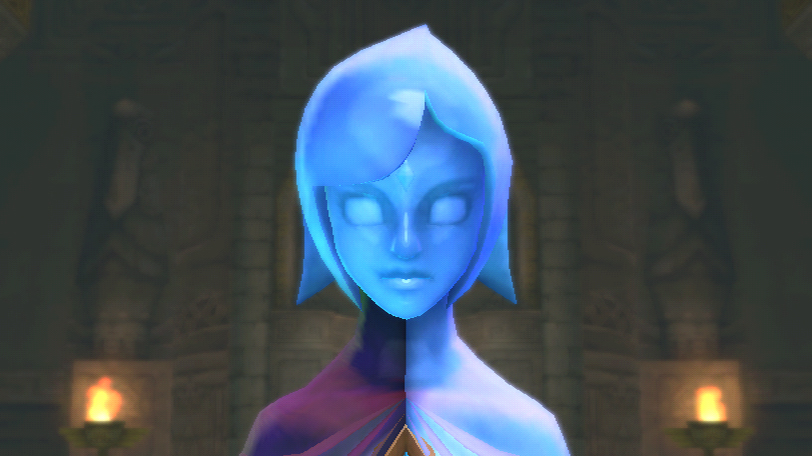
The biggest downside of them all is actually your sidekick and companion, Fi. Fi is the intelligent being or artificial intelligence who lives in your sword, and who's duty it is to guide and assist you on your quest. She can project an image of herself, but can make no physical contact. The only good thing about her is the fact the that she looks cool, but that's about it. Of all the companions who have assisted the different incarnations of Link throughout the thousands of years that different Zelda games take place, many have been unbearably annoying. Navi, your ever-constantly-bugging-you fairy in Ocarina of Time, has often thought to be one of the most annoying companions in any video game. I would have to say Fi is even worse. She seems to have an obsession of telling you the completely obvious facts (and not the things you actually need to know), and making sure she elaborates in full, or more than full, often boring the player to the point where they feel like throwing their controller across the room. It doesn't help that she . . . always . . . talks . . . extremely . . . slowly. . . .
In conclusion, The Legend of Zelda: Skyward Sword may be one of the best games I've ever played. At present it is dueling The Legend of Zelda: Twilight Princess for being both my favorite Zelda game of all time, but also my favorite Wii game of all time. The story, setting, graphics, music, gameplay, variety, locations, and overall ingenuity of it all made for an amazing experience. Nintendo doesn't cease to amaze me, and I can't wait for the next home console Zelda release. No doubt that will be in another five years.
The Legend of Zelda: Skyward Sword gets a well-deserved 10/10.
Tuesday, December 6, 2011
The 13th Tribe by Robert Liparulo
You start out on your adventure with a feeling of... "What the heck?"
The 13th Tribe by Robert Liparulo is one of the most unique novels I have ever read. The beginning completely throws you off track and you have no idea what is going on. Slowly, as the book progresses, things become more and more clear, and the pieces come together. It's a very fun process.
It began when Moses was on Mt. Sinai. Tired of waiting on the One True God, the twelve tribes of Israel began worshipping a golden calf through pagan revelry. Many received immediate death for their idolatry, but 40 were handed a far worse punishment—endless life on earth with no chance to see the face of God.
This group of immortals became the 13th Tribe, and they’ve been trying to earn their way into heaven ever since—by killing sinners. Though their logic is twisted, their brilliance is undeniable. Their wrath is unstoppable. And the technology they possess is beyond anything mere humans have ever seen.
Jagger Baird knows nothing about the Tribe when he’s hired as head of security for an archaeological dig on Mt. Sinai. The former Army Ranger is still reeling from an accident that claimed the life of his best friend, his arm, and his faith in God.
The Tribe is poised to execute their most ambitious attack ever and the lives of millions hang in the balance. When Jagger’s wife and son are caught in the crossfire, he’ll stop at nothing to save them. But how can one man stand against an entire tribe of immortals?The story of The 13th Tribe centers around a group of people who call themselves just that: the 13th Tribe. It turns out that they were formed around 3,500 years ago around the time of the Book of Exodus. They were cursed with immortality, forever destined to stay the age they were when their band was formed, whether infant or old weakling. Originally numbering forty, only eight members have stayed true through present day to carry on what they believe to be their mission: to eliminate those who would bring harm to the innocent. Or, in short, sinners.
As a mixture between historical fiction, science fiction and modern-day thriller, The 13th Tribe kept my attention until the end, though all of the mishaps, plot twists and stunning showdowns. Few writers can write hand-to-hand combat as does Robert Liparulo, and few can make their characters become so... alive. Through the entirety of the story you will grow to sympathize and love or hate each and every character, and in the end the main protagonist, Jagger Baird, became one of my all-time favorite fictional characters.
The book surprisingly had the occasional feel of a self-published novel, but that was for the mere reason that I read a pre-edited copy—the author's first draft, if you will. The novel releases to stores in April 2012, and I definitely recommend picking it up.
In conclusion, The 13th Tribe is a spectacular adventure of a sort I have never seen before. It contains plot twists and surprises that you really don't see coming, and when they're led up to you can almost feel your eyes growing bigger. It is full of action, drama, adventure, and just plain awesomeness. For sure, it was one of the best novels I have read this entire year.
Wednesday, June 8, 2011
Day 04 - The Egg
Indie Video Gaming Week, Day 04 - Game Review: An Untitled Story
Yes, I'm late again. Yes, I reviewed this game before. Is there any reason why I can't review something twice? Besides, this is Indie Video Gaming Week, I need to review something!

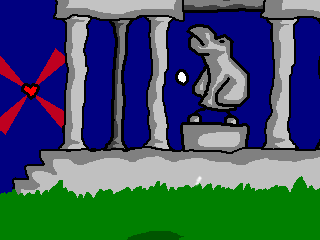
Welcome to the land of . . . well, I really don't know. The land doesn't have a name. It's untitled, just like the game. And yes . . . you are an egg.
An Untitled Story is a game about an untitled egg, journeying across an untitled land, looking for untitled adventure. The only thing wrong with that is a question. What is "untitled adventure"? Well, I would say this game is untitled adventure.
AUS, as it is called for short, is a 2D exploration platformer created in two years by Matt Thorson. I was not able to play through the entire game before writing this review, because the game is so dang huge. Beating the entire game wasn't necessary though, because I've beaten it many times before.
In An Untitled Story, the story is as subtle as the average Metroid game's story is, and it is filled with dozens of different locations (from inside a tree, to a volcanic passageway, to an icy castle floating in the sky), numerous bosses, and tons of collectibles.
Of the three games I've reviewed this week, this game is the longest and, in my opinion, the best (though I would recommend all of them to everyone). There are four main difficulty levels (and one you can unlock), each dramatically altering the game difficulty.
The first time I played the game, I thought I had almost beat the game after a while. What I didn't realize then, is that I was probably less than a tenth of the way through the game. And the bazillion power-ups and health upgrades hidden all around the game world didn't help in making it any shorter.
Like the last two games, I strongly recommend An Untitled Story. It is one of the best games I have ever played. Ever.
Download An Untitled Story for free from Matt Thorson's Website
Anyway, that ends the game reviews. The last three days of the week will consist of interviews. Talking with the men who made these wonders.
Until later,
Reuben Horst
Yes, I'm late again. Yes, I reviewed this game before. Is there any reason why I can't review something twice? Besides, this is Indie Video Gaming Week, I need to review something!
Welcome to the land of . . . well, I really don't know. The land doesn't have a name. It's untitled, just like the game. And yes . . . you are an egg.
An Untitled Story is a game about an untitled egg, journeying across an untitled land, looking for untitled adventure. The only thing wrong with that is a question. What is "untitled adventure"? Well, I would say this game is untitled adventure.
AUS, as it is called for short, is a 2D exploration platformer created in two years by Matt Thorson. I was not able to play through the entire game before writing this review, because the game is so dang huge. Beating the entire game wasn't necessary though, because I've beaten it many times before.
In An Untitled Story, the story is as subtle as the average Metroid game's story is, and it is filled with dozens of different locations (from inside a tree, to a volcanic passageway, to an icy castle floating in the sky), numerous bosses, and tons of collectibles.
Of the three games I've reviewed this week, this game is the longest and, in my opinion, the best (though I would recommend all of them to everyone). There are four main difficulty levels (and one you can unlock), each dramatically altering the game difficulty.
The first time I played the game, I thought I had almost beat the game after a while. What I didn't realize then, is that I was probably less than a tenth of the way through the game. And the bazillion power-ups and health upgrades hidden all around the game world didn't help in making it any shorter.
Like the last two games, I strongly recommend An Untitled Story. It is one of the best games I have ever played. Ever.
Download An Untitled Story for free from Matt Thorson's Website
Anyway, that ends the game reviews. The last three days of the week will consist of interviews. Talking with the men who made these wonders.
Until later,
Reuben Horst
Thursday, April 21, 2011
Metroid Fusion
Somebody find me a game series that I would enjoy more than the Metroid series (especially the 2D games). I dare you.
Chronologically, Metroid Fusion for the Game Boy Advance is the final game in the Metroid series so far. The galactic bounty hunter known as Samus Aran was attacked by a strange organism on the planet known as SR388. This organism was later revealed to be called the X parasite. After barely surviving, Samus was dispatched to an abandoned space station orbiting the planet to find out what happened to the crew on board and to the X parasites.
What Samus finds on this space station, the Biological Space Laboratories, is a completely abandoned facility, with the exception of plenty of monsters, and X parasites all over the place.
This is a game that I loved since almost before I ever bought it. The actual story of how I bought it is interesting enough. I had to go through at least 10 different GameStops before finally finding one that had the game—and the store that finally had it was actually the one that I looked in first.
But that was, say, six months ago. I got about 3/4 of the way into the game before, and then got stuck. Here I came back months later and restarted, and this time I got through the game.
Why do I love this game so much? So many times you get struck for hours and don't know what in the world you're supposed to do, and then once you figure it out, you gasp at the ingenuity of the developers. When you get to a place where you have no clue what do to, it feels so good when you figure it out. For this reason, I would recommend you not use a guide at all for this game, even if you can't figure out what to do for, say, ten hours. The reward feeling you get when you solve the problem is worth it.
I loved the story of this game, I loved the characters (however very few there were), and I loved the progression. Throughout the game there is creepy music in places where it ought to be, making the game actually creepy. The bosses are impossibly fun, and by the end you start to get happy when you die while fighting one (because it means you get to fight it again).
There are a few minor downsides, such as not being able to explore the ship more with all of your recovered abilities once you beat the game, but the awesome parts of this game outweigh the downsides so much, that this game deserves a solid 5/5.
~Reuben/Arkatox~
Friday, March 25, 2011
The Phantom Tollbooth
The Phantom Tollbooth by Norton Juster was first read to me when I was probably five years old. Since then, I've read it several more times. Doesn't sound too hard? I'm the type of person who can't read a book over again unless it's been perhaps three years since the last time I read it. The glory of young adult fiction, which The Phantom Tollbooth is considered to be, is that I can read it multiple times.
If anyone simply won't read this book because it's considered young adult fiction, like for junior high kids, I'm personally going to go their their house and sock them in the face. This book is unique in more ways than I can say. Norton Juster is a total epic genius, and forever he'll have my respect.
This novel is an enigma. Is it an allegory? Is it a fairy tale novel with allegory elements? Nobody completely knows what it is, so I'll leave it at being an enigma.
Wikipedia describes the book as a "children's adventure novel", which I believe that's exactly what it is. It's full of adventure, knowledge, and content that would make a kid enjoy it. But remember, we're all kids in our own way.
The story is focused on a boy named Milo. He thinks life is dull. Everything is boring, and he doesn't care. He's just a lowly kid who can drive a car and has one in his room (that's one thing that I thought was interesting, even though he's portrayed to be in possibly fifth or sixth grade). But he doesn't care much about the car either.
One day, as he comes home from school and a day of boredom, he comes across a strange package addressed to him. In his bedroom. Yeah, the same bedroom with the car that he can drive. Inside the package was a tollbooth, some signs, and some coins. A message that came with it told him to set up the tollbooth and the signs, and drive up to it (paying a toll with one of the coins), and then go on an adventure.
Confused but bored, Milo decided to do this, and suddenly, after he paid the toll, he was in another world, driving down a road in his car. Along the way he comes across many strange places and creatures, and in all truth, his life was never the same again.
He was sent out on a mission with two friends he made along the way. Tock, a watchdog that literally had a watch built into him, and the Humbug, who actually was a giant bug, helped Milo along the way in his quest (appointed to him by Azaz, the king of Dictionopolis) to save the two princesses, Rhyme and Reason, so that rhyme and reason could literally return to this strange world known as the Kingdom of Knowledge.
The way was long and tricky, but in the end . . . I'm not going to spoil it for you!
I'll just say this book was very well written. It's full of puns and it plays on the English language a lot. Plenty often it's confusing, but the more you read it, the more you understand. Norton Juster is a complete genius, and this book will forever be a favorite.
~Reuben/Arkatox~
P.S. As a side note, I lost my DSi, and the game I was playing. This pretty much means no review for that game (not too big of a deal, except I can't finish it), and I'm getting a 3DS in a few days when it comes out anyway.
Edit 02/09/12: My apologies for the postscript. It was appropriate at the time I wrote the review, but people are no longer going to find this review from reading my blog posts in order, so it's a little awkward now. :P
Thursday, February 24, 2011
Wario Land II
Ah, Wario Land II. The Game Boy Color was such an amazing era. . . . Most people I know don't want to try this game because (1) they hate Wario or (2) they've played Wario Land 4 and think it must be a lot better. It's not. In fact, Wario Land 4 is a total piece of crap compared to the rest of the series.
In Wario Land II, you play as, no duh, Wario. Yes, that same character who nowadays is always acting like a total moron and acting inappropriately. That is the Wario that I hate. This is the Wario that I love.
You travel through five worlds, each consisting of five levels, to get to the lair of the evil Captain Syrup, so you can steal back the treasure that she stole from you. Yes, over the years Wario has stayed just as greedy as he was back when this game was made, but it's one of the few parts of his personality that have carried over time.
There are enemies, and they can do different things to Wario. Enemies sometimes cripple Wario in some ways, and other times it seems like they give him a power-up. Sometimes you can get to other places that otherwise couldn't from being "crippled" by certain enemies' attacks.
Wario Land II is long, challenging, and literally jam-packed with secrets. There are as many secret levels are there are normal levels, and the secret exits and passageways aren't easy to find at all. For an unexperienced player, you could spend literally months trying to find all of the secrets in this game. This is why it is one of my favorite games ever made for any system ever. Nothing, no Wario Land 4, no Call of Duty: Black Ops, can beat this game in my standards, unless there's another 2D platformer that goes even deeper.
==Pros==
-Very long game, all secrets included
-Jam-packed with hard-to-find secrets
-Super addicting gameplay
-One of the best games ever made
==Cons==
-If you've 100% completed the game too many times, it's not quite as awesome (but it's still awesome nonetheless)
-Some enemies can get pretty annoying
-Sometimes you spend forever trying to get to a secret passage, and then you finally do, and find out you're not suppose to get there that way (but oh well, you got there anyway!)
~Reuben/Arkatox~
Subscribe to:
Posts (Atom)